
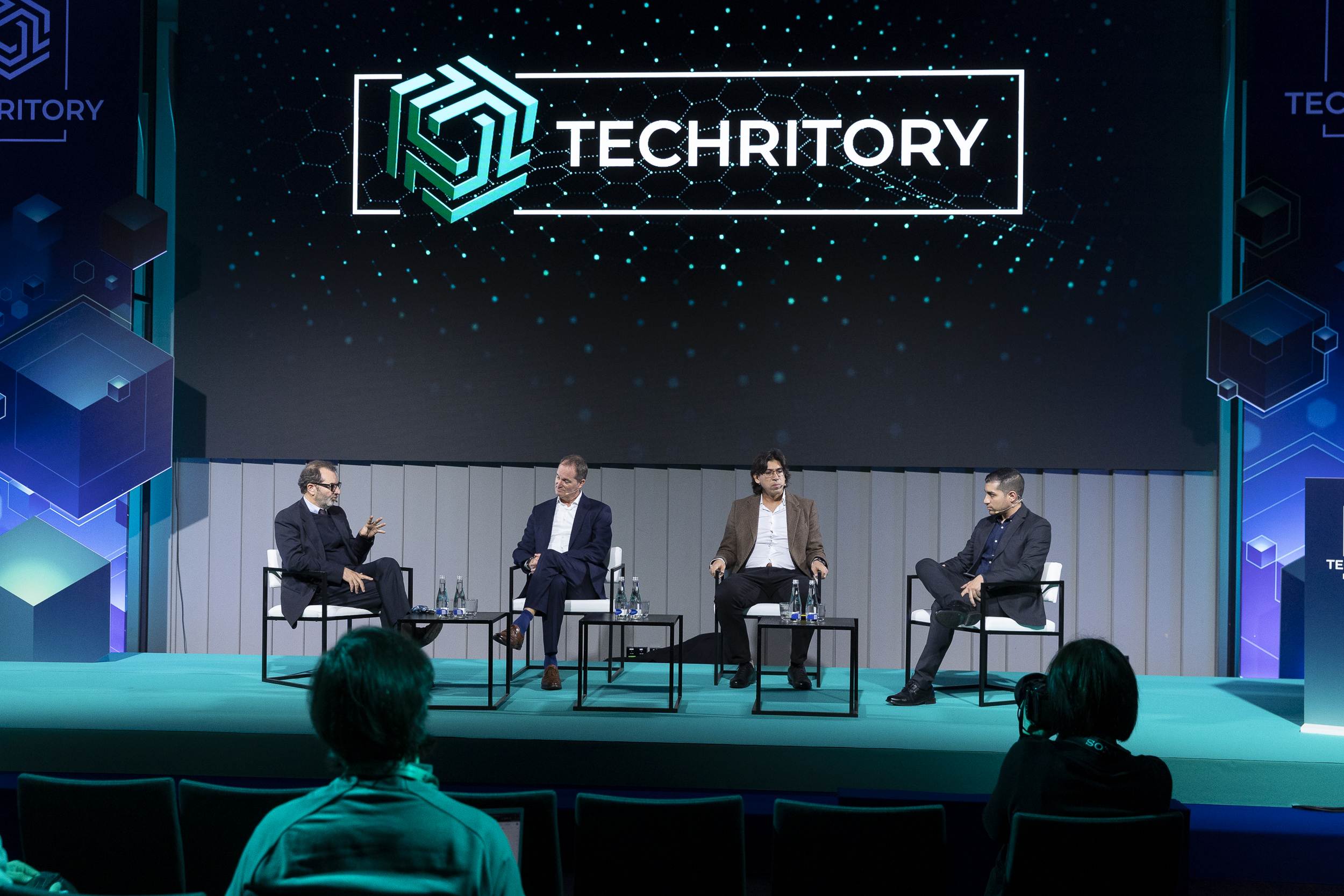
EURO-3C join a panel at TECHRITORY 2026 on Exploring the Economic and Social Impact of 6G
- Will 6G bring new features that operators can monetize? Or use for better network economics?
- What will be the economic impact 6G after 2030 in terms of additional GDP?
- Will 6G benefit more the mobile value chain or productivity of adopters
- Will 6G create social benefits in terms of new jobs and fiscal benefits?
These questions were at the centre of the panel discussion “Beyond Networks: the Economic and Social Impact of 6G”, held on 22 October 2026 during Techritory in Riga, Latvia.
Organised by Raffaele de Peppe, Vice Chair and Board Member of the 6G Industry Association (6G-IA), under the SNS CO-OP project, the session brought together representatives from the telecommunications industry and the European 6G research ecosystem to explore the potential economic benefits of next-generation networks, their impact on industrial productivity and the opportunities they could create for businesses and society.
Arturo Torrealba, Head of Future Connectivity at Telefónica and Project Coordinator of EURO-3C, participated alongside Raffaele de Peppe; Colin Willcock, Board Chair of 6G-IA; and Harry Aquije Ballon, Economist at GSMA.
Beyond connectivity: Understanding the economic value of 6G
As Europe prepares for the transition towards 6G, attention is increasingly turning to the economic and societal value that next-generation networks could generate.
The panel explored several questions that will influence the future development and adoption of 6G technologies.
One central topic was the potential for 6G to introduce new capabilities that telecommunications operators could monetise, while also improving network economics. Beyond the telecommunications sector, the session considered how 6G could contribute to economic growth after 2030, particularly through increased productivity across industries adopting advanced connectivity solutions.
Another important dimension was the distribution of economic benefits. Will the greatest value remain within the mobile telecommunications ecosystem, or will it emerge through productivity gains and new applications in sectors using 6G-enabled technologies?
The discussion also addressed the wider social implications of 6G, including its potential contribution to employment and public revenues.
These questions highlight the importance of considering the economic and societal dimensions of future digital infrastructure alongside its technological development.
Connecting 6G innovation with EURO-3C’s vision
The themes explored during the panel are closely related to the ambitions of EURO-3C, which aims to establish a large-scale, open, federated and sovereign European infrastructure for converged Telco-Cloud-Edge services.
Bringing together 85+ organisations across Europe, EURO-3C is working to connect distributed telecommunications, cloud and edge computing capabilities across multiple providers and countries.
The project seeks to demonstrate how federated digital infrastructure can enable interoperable services, support emerging applications and create new opportunities for European industries.
Its research and innovation activities address several aspects relevant to the economic development of next-generation networks, including Telco-Cloud convergence, multi-level federation, interoperable Everything-as-a-Service (XaaS), AI-enabled orchestration and business sustainability.
Through use cases in automotive, transport, energy and public protection and disaster relief, EURO-3C aims to demonstrate how these capabilities can support practical applications and new service opportunities.
In this context, understanding the economic value of future connectivity is an important consideration for the project’s work towards sustainable business models and a competitive European digital infrastructure ecosystem.
Watch the full panel discussion: Beyond Networks: the Economic and Social Impact of 6G – Techritory 2026
Learn more about EURO-3C: https://euro-3c.eu/