
EURO-3C and ETSI Explore the Future of Open Federated Telco-Edge-Cloud Infrastructure at Network X 2026
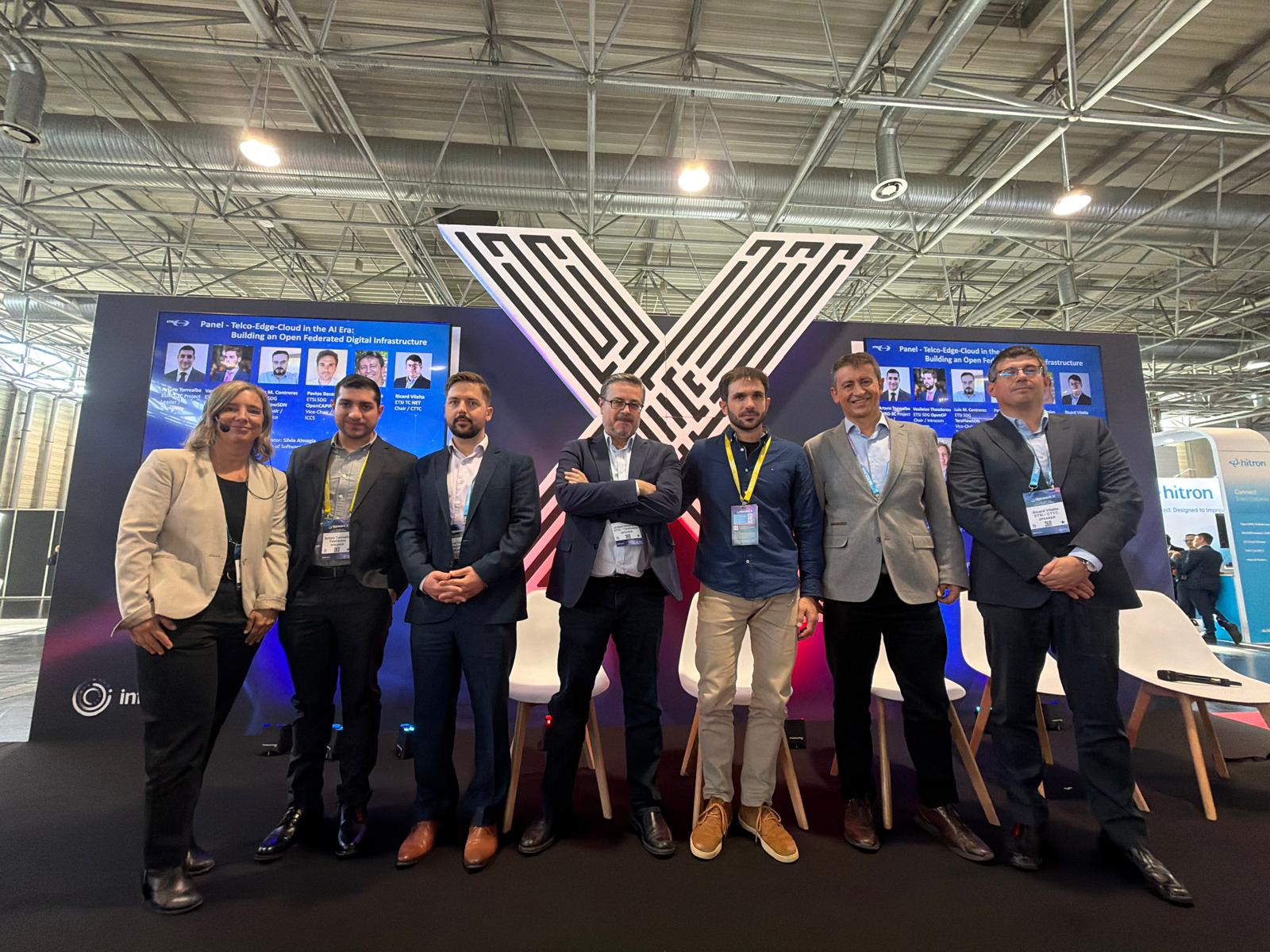
On 13 October 2026, EURO-3C joined standardisation experts at Network X in Vienna for the ETSI workshop “Telco-Edge-Cloud in the AI Era: Building an Open Federated Digital Infrastructure”. Held on the Innovation Stage from 13:30 to 15:00, the session explored how open-source technologies, standards and European research initiatives can work together to accelerate the development of an interoperable, intelligent and federated digital infrastructure.
The workshop brought together representatives from the ETSI Software Development Groups (SDGs), the newly established ETSI Technical Committee on Federated Network, Edge, Cloud and AI Technologies (TC NET), and European initiatives including EURO-3C and SOVEREIGN-6G.
The session opened with Silvia Almagia, Director of Software and Standards at ETSI, who introduced the challenges of technological fragmentation, limited convergence between connectivity and cloud services, and the growing importance of security, regulation and digital sovereignty. She highlighted ETSI’s approach of combining standards and open-source software, where specifications guide implementation while practical development and testing help refine standards, accelerate interoperability and encourage wider adoption.
Building on this introduction, Arturo Torrealba Ferrer, EURO-3C Project Coordinator at Telefónica, presented the project’s vision. He outlined EURO-3C’s ambition to establish an open, secure, sovereign and federated pan-European Telco-Edge-Cloud infrastructure, bringing together connectivity, computing and AI capabilities across multiple providers and domains. Supported by interoperability, programmability and AI-enabled orchestration, the project aims to move beyond fragmented infrastructures towards an operational European Connected Collaborative Computing Networks (3CN) ecosystem, enabling providers to collaborate while supporting new services and business opportunities.
While EURO-3C presented the broader European infrastructure vision, the following presentations explored the technological components required to make such federation operational.
Vasileios Theodorou, ETSI SDG OpenOP Chair at Intracom Telecom, introduced “Open Operator Platform: The Open-Source Telco Cloud Platform Where Telecom, Cloud, AI and Data Ecosystems Converge”. Building on European research initiatives, OpenOP provides a modular open-source platform supporting network and testbed federation, standardised capability exposure through CAMARA APIs, application orchestration and AI-driven interaction. Its objective is to make advanced Telco Cloud capabilities more accessible to operators, developers, researchers and vertical industries, providing a technological foundation for the development of federated ecosystems.
Moving from the platform layer to the underlying connectivity infrastructure, Luis Miguel Contreras Murillo, ETSI SDG TeraFlowSDN Vice-Chair at Telefónica, presented “The Role of TeraFlowSDN in the Federated Telco-Edge-Cloud-AI Execution Fabric”. He explained how AI applications are transforming network requirements, with distributed workloads generating increasingly dynamic and critical traffic between devices, edge infrastructures and cloud environments. TeraFlowSDN addresses these challenges through programmable connectivity, telemetry, policy management and assurance, helping ensure that network resources can be coordinated with distributed computing and AI workloads across multiple domains.
However, connecting and orchestrating infrastructures is only part of the challenge. Applications and services must also be able to discover and access capabilities consistently across different providers.
This aspect was addressed by Pavlos Basaras, ETSI SDG OpenCAPIF Vice-Chair at ICCS, in “OpenCAPIF in the Telco-Edge-Cloud Continuum: A Common Framework for Exposing and Consuming Capabilities Across Domains”. He presented OpenCAPIF as an open-source implementation of the 3GPP Common API Framework, designed to support secure and consistent API exposure and consumption. By simplifying API discovery, onboarding, publishing and monitoring, OpenCAPIF contributes to interoperability and enables applications to access capabilities across federated Telco-Edge-Cloud environments.
Building on these technical foundations, the workshop then explored how distributed infrastructure capabilities can be transformed into services that deliver tangible business value.
Jesús Iglesias Maqueda, Innovation Lead for Future Connectivity at Telefónica and ETSI SDG OpenSlice member, presented “ETSI SDG OpenSlice: From Telco-Edge-Cloud Capabilities to Business Services”. OpenSlice provides an open-source operational support system that transforms distributed network and cloud capabilities into manageable services. Through service catalogues, ordering, lifecycle orchestration and standard TM Forum APIs, it connects infrastructure operations with customer-facing offerings. This approach illustrates how federation can extend beyond technical interoperability to support orderable, commercially viable services and sustainable business models.
Together, these presentations demonstrated how the different ETSI open-source initiatives address complementary layers of the Telco-Edge-Cloud ecosystem. Yet, for these technologies to operate seamlessly across providers and national borders, common specifications and coordinated standardisation efforts are equally essential.
Addressing this dimension, Ricard Vilalta, ETSI TC NET Chair and ETSI SDG TeraFlowSDN Chair at CTTC, introduced “ETSI Technical Committee on Federated Network, Edge, Cloud and AI Technologies (TC NET)”. He highlighted a central challenge: although connectivity, computing and AI are already converging in real-world deployments, their standards remain fragmented. The newly established TC NET aims to address this gap by developing common specifications for a programmable, intelligent and federated cloud-network-edge-device continuum. Its work seeks to support interoperability and cross-domain operations while complementing existing standardisation activities.
Following the presentations, the workshop concluded with a panel discussion moderated by Silvia Almagia, bringing together the six speakers to examine how open source, standards, federation and AI can jointly contribute to an operational Telco-Edge-Cloud continuum that can be deployed and managed across Europe.
The discussion agenda explored the complementary roles of European research projects, telecommunications operators, open-source communities and standardisation organisations in transforming technological innovation into scalable infrastructure. For EURO-3C, the discussion focused particularly on what distinguishes the project from previous European telco-cloud and edge initiatives, including its ambition to establish an open, multi-supplier and federated infrastructure at European scale. Another important consideration was how to ensure the project’s long-term sustainability and commercial relevance beyond its three-year implementation period.
The panel also addressed the contribution of initiatives such as SOVEREIGN-6G and ETSI OpenOP to establishing an AI-native Telco Cloud foundation, as well as the importance of transforming research outcomes into sustainable, accessible technologies that can benefit the wider industry.
The session illustrated how these different initiatives can complement one another: EURO-3C provides the broader European deployment vision, OpenOP addresses the federation and platform layer, TeraFlowSDN enables programmable connectivity, OpenCAPIF facilitates capability exposure, OpenSlice supports service operations and commercialisation, and TC NET contributes the standardisation framework needed to bring these components together.