Blog #6 – Rethinking European Cloud Ambition: Competing Through Trust, Openness, and Collaboration
 Costa Tsourkas
Real Wireless
Head of Strategic Innovation

 David Regeczi
TNO
Senior Consultant


Hanne-Stine Hallingby
Telenor
Senior Research Scientist

Hyperscalers’ scale, market share and sustained investment create a substantial competitive barrier for European providers. Europe’s cloud-infrastructure services market (IaaS, PaaS and hosted private cloud) reached €61 billion in 2024 and generated a further €36 billion during the first half of 2025 (according to a July 2025 market analysis by Synergy Research Group). European providers collectively retained only around 15% of that, while Amazon Web Services (AWS), Microsoft and Google together accounted for 70%. SAP and Deutsche Telekom remained the largest European-headquartered providers, with only around 2% each. European providers’ collective share stabilised at around 15% in 2022, declining from 29% in 2017. This signals both a continuation of hyperscaler dominance in a growing market and that European providers are capturing their share of the growth.[1]
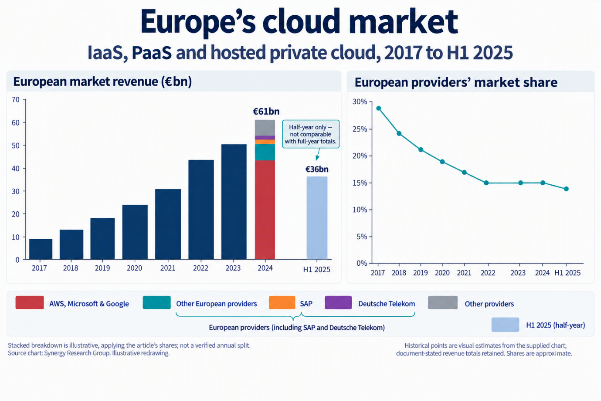
Figure 1: Europe’s cloud market: IaaS, PaaS and hosted private cloud, 2017 to H1 2025
The challenge: Synergy reported that US cloud providers were investing approximately €10 billion per quarter in European capital-expenditure programmes. Its assessment emphasises the financial resources, long-term investment horizon and operational excellence required from European cloud challengers. Indeed, European providers’ revenues more than tripled between 2017 and 2024 however, in a regional market that grew sixfold over the same period. The subsequent European market-share stabilisation therefore represents a firmer foothold, but not evidence that they are closing the gap to hyperscalers. [1]
Nevertheless, two observations are positive and promising. First, the expanding total addressable market (TAM) offers European providers scope for substantial revenue growth even without gaining market share; a stable share of a growing market can support a larger business. Second, stabilisation of market share suggests a more resilient competitive foothold from which to build. This is still not yet evidence of a sustained recovery in European providers’ share. The strategic implications are to pursue specific local customer needs and differentiated services, and seek partnerships where appropriate.
Yet, despite being the underdogs, Europe’s cloud firms have critical cards to play. Recent trends show opportunities for differentiated alternatives:
Data Sovereignty Concerns: European cloud-customers are taking an increasingly stringent approach to the governance of sensitive and strategically important data, particularly where their cloud services may be subject to legal jurisdictions that are outside EU. These concerns were reinforced by the CJEU’s Schrems II judgment of 16 July 2020, which invalidated the EU–U.S. Privacy Shield after finding that aspects of the U.S. surveillance and redress framework did not provide protections essentially equivalent to those required under EU law [2]. The Privacy Shield has since been replaced by the EU–U.S. Data Privacy Framework (DPF), adopted in July 2023 following additional U.S. safeguards, including Executive Order 14086 and the establishment of the Data Protection Review Court. The DPF remains valid and operational, although aspects of the underlying U.S. safeguards and institutional arrangements continue to be subject to judicial challenge and regulatory, corporate and public scrutiny.
Against this background, European cloud buyers and end-users may still need to consider the potential for lawful extraterritorial access by U.S. authorities to data controlled by U.S.-headquartered providers, including in some circumstances where data are stored within the EU [3]. This does not mean that data held by U.S. hyperscalers are inherently non-compliant with EU law; rather, it creates an additional dimension of legal, operational and geopolitical risk that organisations, particularly those handling sensitive, regulated or strategically important data, may need to assess as part of their cloud and data-governance strategies [4]. Major hyperscalers have responded with enhanced European and sovereign-cloud offerings, including measures intended to strengthen EU-based data residency, operational control and technical safeguards [4][5]. These initiatives can materially reduce some risks, but debate remains over the extent to which technical and organisational measures alone can address concerns arising from the jurisdiction, ownership and ultimate control of service providers. From a risk-sensitive European perspective, data sovereignty should therefore be treated not as a binary distinction between European and U.S. providers, but as a governance and resilience consideration requiring assessment of jurisdiction, data location, operational control, access safeguards, legal exposure and provider dependency.
Regulatory and Customer Pushback: Europe’s digital regulators are taking an increasingly assertive stance across several relevant areas. The Digital Markets Act (DMA), Digital Services Act (DSA), GDPR, and most recently the AI Act being phased into application, all impose strict requirements that cloud providers must meet[6]. EU-based providers can often more readily comply and even turn compliance into a selling point (privacy by design, AI transparency, trust, etc.), whereas the big players tend to adjust only under pressure[3]. Moreover, European enterprises – especially in the public sector and regulated industries – are starting to demand “sovereign cloud” options in RFPs and contracts based on some reports from the Nextcloud summit[5]. Governments and critical infrastructure sectors (health, finance, defence) are exploring or mandating local cloud solutions for certain data, creating a market opening for local providers.
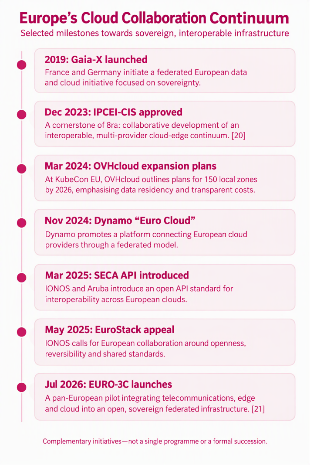 Unified European Response Emerging: Perhaps most importantly, European cloud companies are realizing they shouldn’t go it alone. There’s a growing movement to band together, federate services, and present a unified alternative. Initiatives like Gaia-X (launched 2019) have brought hundreds of European players together to define common standards for data portability and sovereignty[7][8]. More concretely, in 2025 a group of European providers (Aruba, IONOS, and Dynamo, with others invited) introduced the Sovereign European Cloud API (SECA) – an open standard API to make their clouds interoperable[3]. This is laying the foundation for a EuroStack: a federated European cloud ecosystem where multiple providers’ offerings can interconnect seamlessly[6][3]. Among the latest initiatives in this continuum are 8ra, bringing together IPCEI-CIS projects to develop an interoperable, multi-provider cloud-edge continuum [9], and most recently EURO-3C, developing a large-scale, open and sovereign pan-European pilot integrating telecommunications, edge and cloud services [10].
Together, they advance the transition from common principles and interfaces towards federated infrastructure and practical service delivery.
Ferri Abolhassan, CEO of T-Systems International GmbH and Member of the Board of Management of Deutsche Telekom AG, emphasized, “By the end of 2026, our cloud will be functionally on par with the major hyperscalers – and in terms of pricing, we already are today.” [11]
The various initiatives outlined above indicate a bolder ambition to rethink the established hyperscaler paradigm altogether, or as IONOS CEO Achim Weiß puts it, “Let’s stop trying to compete with hyperscalers on their terms, and start leading on ours. Let’s prove that European collaboration is not a compromise – it’s our competitive edge.”[6].
In short, while hyperscalers enjoy incumbent advantages, European providers have strategic differentiators aligned with the continent’s values and needs, which increasingly seem to resonate well beyond European shores. The time is ripe – as Achim Weiß emphasized in an open call to Europe’s cloud industry – to “build something bigger together” for a “strong, sovereign, independent digital Europe”[6].
Follow-up articles and discussion papers will seek to outline an emerging open, competitive ecosystem strategy, leveraging these differentiators: from sovereignty and compliance leadership to unique telco synergies, from cooperative scaling to customer-centred open services marketplaces.